Rationale/Purpose
This document defines the framework for leading and sustaining data governance initiatives concerning the University of Iowa Data Warehouse. Its purpose is to cultivate an institutional culture grounded in the shared responsibility for ensuring data quality, data accessibility, and the enforcement of university data warehouse governance policies.
This document serves as a subordinate standard to the University of Iowa's overarching Institutional Data Policy, The University Operations Manual, and other relevant university policies that seek to ensure university data effectively supports evidence-based decision-making processes, operational excellence, and strategic advancement in alignment with the university's mission.
Scope
This framework applies to:
- All institutional data contained within the University of Iowa's Data Warehouse.
- All information technology systems, services, applications, and processes that generate, collect, store, maintain, transmit, transform, or report protected institutional data within or from the University of Iowa’s Data Warehouse environment. This includes but is not limited to: Campus Data, MAUI, ICON, reporting tool, or other applications where warehoused data may be imported into.
- All individuals who access or intend to access any institutional data housed within the Data Warehouse.
Guiding Principles
Data warehouse governance initiatives will adhere to these guiding principles, consistent with the principles established in the University of Iowa's Institutional Data Policy:
- Transparency: It should be clear how and when decisions are made, and processes are created.
- Consistency: All governing decisions should be applied consistently.
- Accountability: Progress toward institutional data management goals will be measured, tracked, and in compliance with policies, procedures, and current data governance best practices.
- Agility: All processes and requirements should be adaptable to the ever-changing data and technology environment.
- Change Management: The successful implementation of new processes and requirements will involve a proactive and concerted change management strategy engaging affected university staff.
Data Warehouse Governance Structure and Roles
Oversight Body: Data Warehouse Governance Committee (DWGC)
The Data Warehouse Governance Committee’s (DWGC) purpose is to support the quality, accessibility, and security of data within the University of Iowa's data warehouse. It is charged with addressing, at its discretion, issues that affect the use and management of the university’s warehoused institutional data assets.
The DWGC provides an enterprise perspective to governing data but does not centralize control of data; rather, it creates systems for identifying individual and departmental data curators and guidelines for these individuals to use as they curate data within their responsibility sphere.
- Composition: The DWGC will include representatives from institutional data domains, Data SPARC (Strategic Plan Action and Resource Committee), Administrative Information Systems (AIS), and other units with a vested interest in data governance. Its membership will reflect a broad range of institutional knowledge across functional data areas, promoting shared responsibility for data integrity. A steering committee comprising current DWGC members will be appointed to prioritize governance efforts and optimize resource utilization.
- Responsibilities: The DWGC will convene regularly to formulate recommendations for data policy, strategic investments in systems and tools, and data management practices. These recommendations will be submitted to the provost, AIS leadership, the Chief Information Officer, and the Data SPARC for their consideration.
- Effort Structures: The DWGC may establish standing or ad-hoc subcommittees to address specific areas requiring ongoing attention or specialized expertise. Each subcommittee will:
- Be chaired by a DWGC member
- Include at least one subject matter expert from relevant domains
- Provide progress reports to the full committee
- Operate under clearly defined charters with specific deliverables and timelines
Data Warehouse Governance Hierarchy Diagram
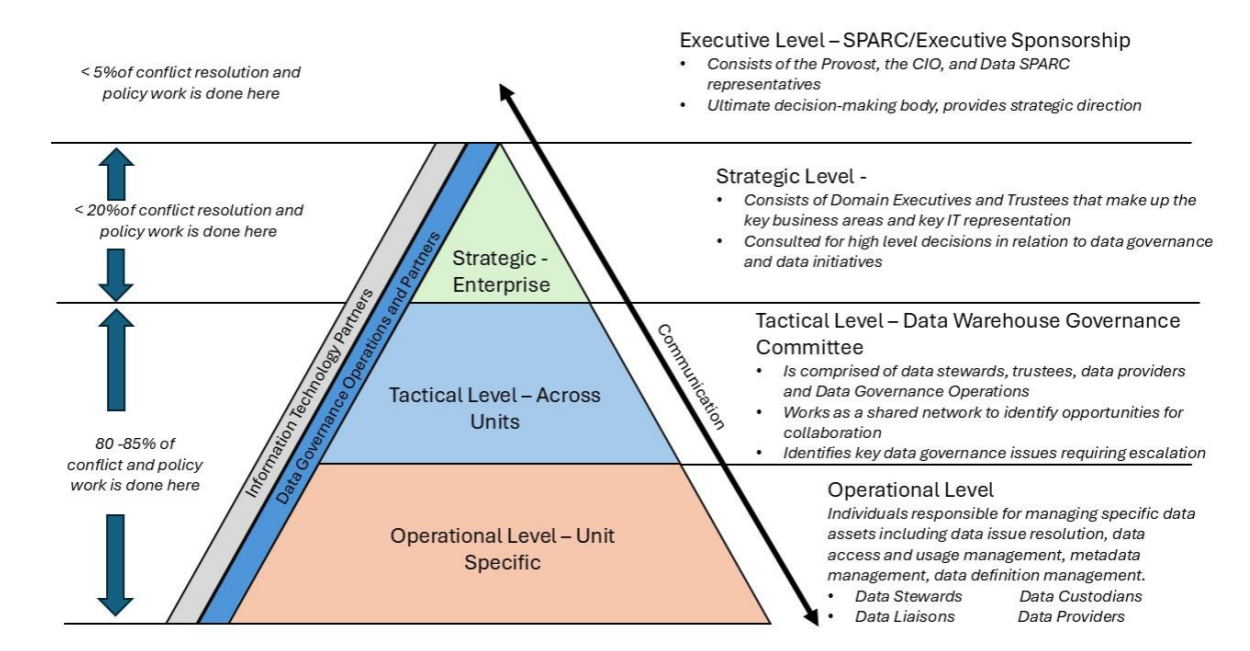
Data Warehouse Roles and Responsibilities
Domain Executive
A domain executive is an executive university administrator who provides direction for a functional area of the university. Domain executives are responsible for establishing procedures for and communicating to the university policies applicable to institutional data domains under their oversight. The domain executive has the highest level of responsibility for the management of institutional data in their area and will interpret and clarify data policy when necessary.
Data Trustee
All university data assets fall under the purview of a data trustee. Data trustees hold the responsibility for their designated data assets, including security level, classification, quality standards, retention schedule, and disposition of data to actor external to the University of Iowa. Data trustees delegate care and day to day management of university data to data stewards. A data trustee serves as the next level escalation path and decision-maker for a data-related concern not resolved at the data steward level.
Data Steward
Data stewards are operational managers who connect technical and business teams within their functional areas. Appointed by data trustees, they manage specific data assets and oversee the daily processes that govern institutional data in the data warehouse.
Data stewards ensure organizational data under their purview meets established standards for quality, accuracy, format, and value. They implement trustee-approved policies while developing best practices for their assigned data domains and serving as the primary contact for problem resolution when issues arise concerning data within their care.
Key Responsibilities include:
Data Quality & Standards
- Define/publish data quality metrics and business rules for data in their care
- Manage metadata and reference data
- Track data lineage and classify sensitive information
- Monitor data capture, maintenance, storage, use, and distribution
- Guide resolution of data quality issues at the warehouse level
Access Management Data stewards create and maintain procedures for:
- Data access protocols and user management
- Adding, removing, and granting user privileges
- Conducting periodic access reviews
- Setting data warehouse access requirements
- Approving access requests based on legitimate business need and "need to know" principles
Policy & Compliance
- Help define, document, and communicate domain-based data governance policies, standards, or data handling/retention policies.
- Ensure compliance with applicable laws (HIPPA, FERPA, GDPR, etc.) regulations, and internal or domain policies
- Serve as the first point of contact for policy interpretation disputes and definition/metric conflicts
- Specify requirements for data usage, storage, re-disclosure, re-purposing, and third-party or AI applications
Problem Resolution & Escalation
- Resolve escalated data issues within their domain
- Escalate complex matters to governance committees or trustees when necessary
- Collaborate with the DWGC to contribute to the shared governance of the data warehouse.
Data Custodians (Data Warehouse Technical Teams)
Data custodians are information technology experts who import data into the data warehouse. Data custodians oversee the safe transport and storage of data, establish and maintain the underlying infrastructure, set security measures, and perform activities required to keep the data intact and available to users. In addition, data custodians are responsible for working with data stewards to develop processes which identify erroneous, inconsistent, or missing data. Data custodians work with data support groups such as the Data Analytics and Insights team, data providers, and data stewards to resolve identified data issues.
Key Responsibilities include:
Technical Infrastructure & Security
- Maintain the data warehouse technical environment, including servers, networks, and storage systems
- Implement and manage security measures such as encryption, operational access controls, and data protection protocols
- Oversee secure data transport and storage processes
- Ensure system performance, scalability, and reliability
Data Processing & Integration
- Manage ETL/ELT (Extract, Transform, Load) processes that bring data into the warehouse
- Import data from various sources while maintaining accuracy and efficiency
- Monitor and optimize data processing workflows
- Ensure successful data integration across multiple systems
Data Quality & Integrity
- Collaborate with data stewards to develop automated processes that detect erroneous, inconsistent, or missing data
- Implement technical solutions to maintain data integrity and availability
- Execute policies, standards, and guidelines that protect data quality
- Monitor system performance
Issue Resolution & Collaboration
- Work with data support groups, Data Analytics and Insights team, data providers, and data stewards to resolve technical data issues
- Coordinate with information security, legal, and privacy teams to ensure data warehouse governance aligns with security and privacy requirements
- Provide technical expertise to support data governance decisions
- Troubleshoot and resolve system-related problems that affect data availability
Data Liaisons
A data liaison serves as the representative for an organizational unit within the university's institutional data framework. While their specific duties can vary, data liaisons act as advisors and resources for their organizational leadership, units, and individual data users. They advocate for using data within their units and facilitate communication between data users and the DWGC, the Data SPARC, warehouse data stewards, and data providers.
Data Providers
A data provider is an individual who supplies institutional data to campus members, offering it as raw data, insights, reports, or dashboards to help drive data-informed decisions.
Data providers ensure data stewards are aware of and approve the intended use of any data being shared with end users. They make sure data is provided to users in a way that aligns with institutional policies and procedures. Data providers are responsible for ensuring users are trained in the appropriate use and handling of the data they receive.
Data Consumers
At the University of Iowa, all employees are data consumers, regardless of their role or level. In today's digital world, all employees interact with institutional data and are expected to understand and abide by the policies that govern its appropriate use. Expectations for data consumers include:
- The use of institutional data solely for fulfilling their job responsibilities within the institution.
- They must use institutional data in a way that complies with all policies regarding data confidentiality, handling, and appropriate use.
- They are expected to work with data liaisons, data providers, and data stewards to understand institutional data and how to use it properly.
- They should utilize institutional resources to improve their individual data literacy skills.