Purpose and Scope
Rationale/Purpose
Institutional Data Policy requires that institutional data be treated as a shared university resource and responsibly managed throughout its lifecycle. To ensure timely and effective resolution of data issues, this procedure establishes clear steps for identification, prioritization, and remediation.
Definitions
- Data Warehouse Governance Committee (DWGC): The body responsible for publishing and maintaining data governance procedures and resources.
- Data Warehouse Governance Steering Committee (DWGSC): The authoritative decision-making body responsible for receiving, triaging, and overseeing resolution of institutional data issues.
- Data Steward: An individual assigned responsibility for a specific data domain who coordinates remediation efforts within their area.
- Data Warehouse Data Issue: A matter requiring governance attention related to decision rights, policy conflicts, data quality, or effective data management in the warehouse.
- Subject Matter Expert (SME): An individual who possesses a deep, authoritative knowledge of a specific topic, process, technology, or profession.
Scope
This procedure is available for institutional data issues such as:
- Decision Rights & Authority: Questions about who has the authority to make decisions regarding specific data elements or processes
Example: Determining which office should define "active student" status. - Policy & Standards Conflicts: Conflicts among policies, procedures, standards, business rules, architecture, and stakeholder interests
Example: Different departments using incompatible definitions for the same metric. - Data Quality Issues: Problems with accuracy, completeness, consistency, timeliness, or validity of data
Example: Systematic discrepancies between source systems and the data warehouse, null values where they shouldn’t be. - Data Management Issues: Other issues related to effective data management in the warehouse
Example: Unclear documentation preventing proper data interpretation - For issues outside this scope: submitters will be redirected to appropriate resources.
Example: Report formatting requests, dashboard enhancements, or one-off data extracts
Procedure
Step 1. Discovery and logging:
The UI Data Warehouse Governance Committee (DWGC) will publish and maintain an institutional data issue intake form on the University of Iowa Data Hub website. The intake form shall be available to anyone with a HawkID and shall collect the following information:
- Name, job title, and department of submitter
- Submission date
- Type of issue (selected from categories identified in the “Scope” section above)
- Detailed description of the issue
- Description of impact or potential impact
- Identification of the system, source, domain, or report experiencing the issue
- Evidence or examples of the issue or its impact (attachments supported)
Submission Confirmation: All submissions will receive a confirmation email with a tracking number and estimated review timeline.
Step 2. Triage, Prioritization, and Partnership
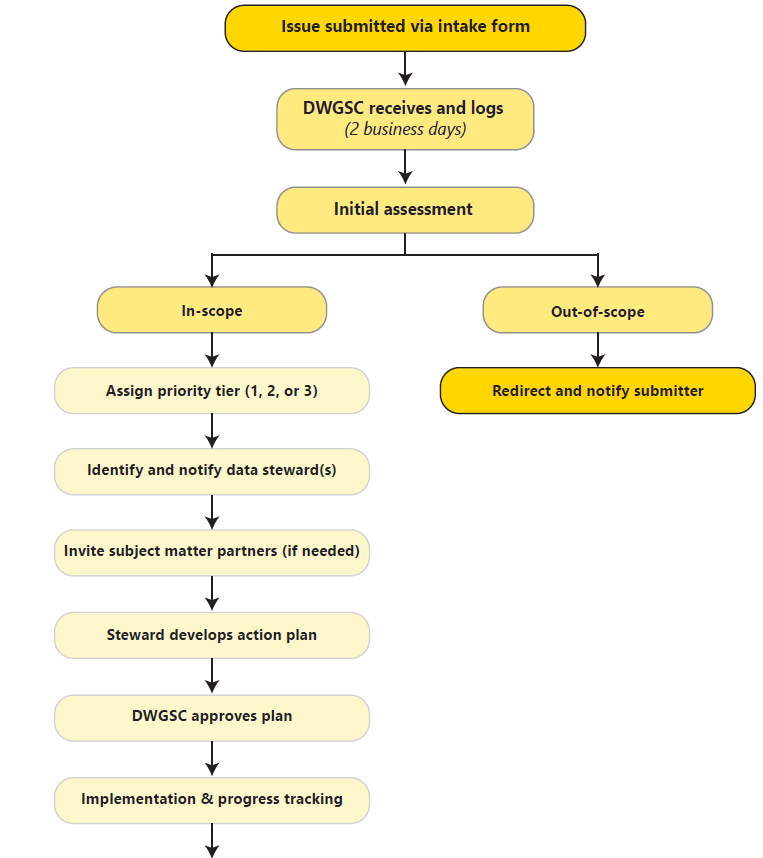
The DWGSC receives and logs all intake form submissions within two (2) business days.
Initial Assessment
The DWGSC will log all submissions within two business days to determine if they raise an in-scope institutional data issue as defined in the “Scope” section outlined above.
- In-Scope Issues: Proceed with triage and prioritization.
- Out-of-Scope Issues: The DWGSC notifies the submitter within five (5) business days, provides an explanation, and redirects them to the appropriate resource or contact when applicable.
Triage Methodology
The DWGSC will assign a priority tier based on severity, urgency, and impact. Priority tiers are defined as follows:
| Priority Tier | Severity & Urgency | Resolution Target | Review Timeline |
| Tier 1 (Critical) | Legal/compliance risk; Campus-wide impact; Data breach or security concern | Immediate action required; Resolution plan within 48 hours | Immediate review |
| Tier 2 (High) | Multiple domains affected; High functional or system impact; Significant user population affected | Resolution plan within 15 business days; Implementation within 60 days | Review within 5 business days |
| Tier 3 (Routine) | Single domain; Low downstream impact; Limited user population | Resolution plan within 30 business days; Implementation scheduled in regular backlog cycles | Review within 10 business days |
Subject Matter Partnership
When a reported issue involves a subject area not represented on the DWGSC, the committee will identify and invite representatives from the affected area to participate as full partners in all related discussion and deliberation.
Assignment
For in-scope issues, the DWGSC will:
- Document all impacted data domains
- Notify the appropriate data steward(s) for each affected domain
- When an issue affects more than three (3) domains or lacks a clear steward assignment, escalate to the full Data Warehouse Governance Committee for broader stakeholder coordination
Role Delineation for DWGSC Members Serving in Multiple Capacities
Some DWGSC members also serve as data stewards or subject matter experts (SMEs). When participating in issue review and prioritization, these individuals act in their governance capacity on behalf of the DWGSC. When serving as assigned stewards or SMEs during remediation activities, they act in an execution capacity. These roles are functionally distinct, and all action plans must be reviewed and approved by the DWGSC in its governance role, regardless of member overlap.
Step 3. Remediation, Resolution, and Documentation
Action Planning
Assigned data stewards and DWGSC will collaborate to:
- Convene relevant stakeholders within the timeline specified by priority tier
- Investigate the issue thoroughly
- Develop an action plan with specific steps, responsibilities, and target completion dates
Progress Tracking
The DWGSC will maintain a centralized tracking log documenting:
- Issue status (Under Investigation, Action Plan Approved, In Progress, Resolved, Closed)
- Key milestones and completion dates
- Any barriers or delays
- Stakeholder communications
Stewards will provide status updates biweekly to the DWGSC for Tier 1 and Tier 2 issues, and monthly for Tier 3.
Decision-Making Framework
When determining appropriate resolutions, stewards must:
- Consider all stakeholder viewpoints and document alternatives considered
- Evaluate technical feasibility alongside functional requirements
- Assess broader impacts on connected systems and processes
- Ensure compliance with relevant policies and regulations
- Document the rationale for the chosen resolution
Operational Boundaries
The DWGSC focuses primarily on data governance decisions. When resolutions have significant impacts on functional operations or system architecture beyond data governance, the DWGSC will coordinate with appropriate functional leadership or IT architecture teams but will defer operational decisions to those bodies.
Communication Planning
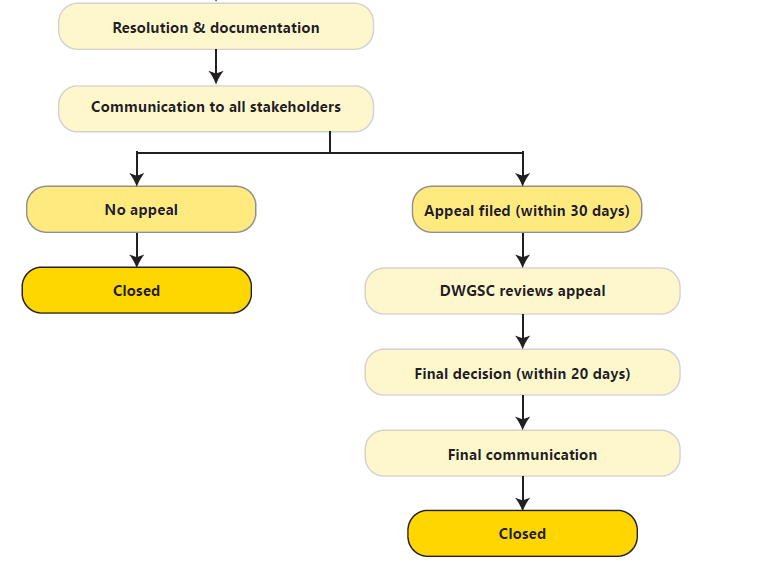
Upon resolution, the assigned data steward(s) will:
- Prepare a written resolution summary including the decision, rationale, and implementation timeline
- Submit the summary to the DWGSC for review
- After DWGSC approval, communicate the resolution to:
- The original submitter
- All identified stakeholders and impacted parties
- Relevant data steward communities
Appeal of Issue Resolution
Any party that receives communication of a resolution may appeal the decision within thirty (30) calendar days of the resolution communication date.
Appeal Requirements
Appeals must be submitted in writing to the DWGSC via email (ui-data-hub@uiowa.edu) and include:
- Reference to the original issue tracking number
- Specific aspects of the resolution being contested
- Proposed alternative resolution with detailed rationale
- Evidence or analysis supporting the alternative approach
Appeal Review Process
- Acknowledgment: The DWGSC acknowledges receipt of the appeal within three (3) business days
- Review: The DWGSC reviews the appeal, gathers additional information if needed, and may convene the original stewards and new stakeholders
- Decision: The DWGSC issues a final decision within twenty (20) business days of receiving the appeal
- Communication: The decision is communicated to all parties with full rationale
- Finality: Decisions on appeals are final, except in cases where new evidence emerges that was not available during the appeal process
Annual Report
By the end of each fiscal year, the DWGSC provides a comprehensive report to the Data Warehouse Governance Committee including:
- Summary statistics on issues received and resolved
- Descriptions of currently unresolved issues with status updates
Analysis of trends and systemic issues
Recommendations for policy or process improvements
Assessment of procedure effectiveness
Process Review
The DWGSC monitors issue volume and complexity quarterly. If the workload becomes unmanageable or if the procedure proves ineffective, the DWGSC will initiate a formal review and propose revisions to this procedure.
Related Data Warehouse Policies and Standards
Below are links to the related policies, guidelines, or standards that currently support data use in the data warehouse.
Process Flowchart